


On Hand-Eating
The Primordiality of Eating from a Psychoanalytic Perspective


At a Glance
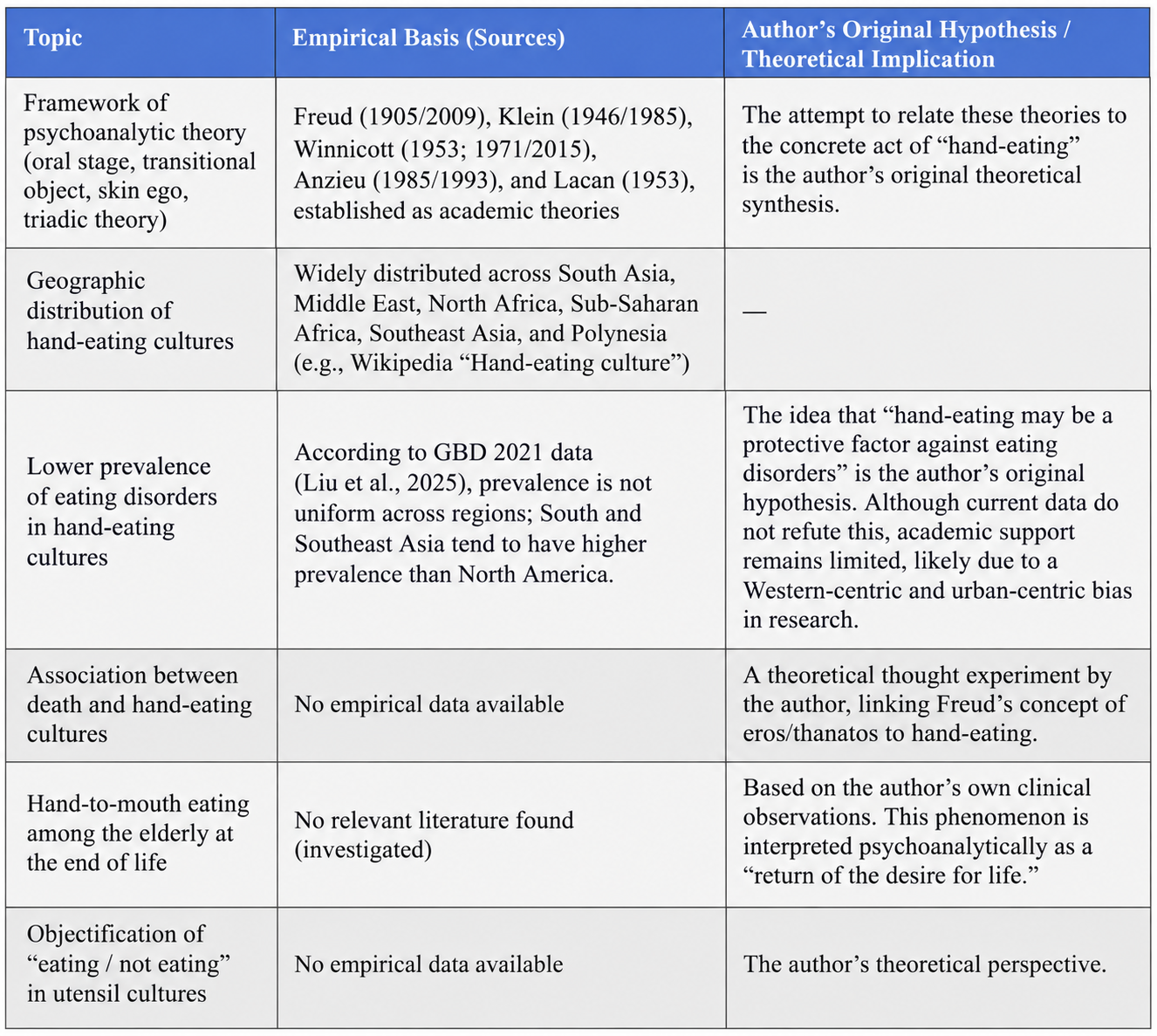
This essay is an attempt to interpret the practice of hand-eating through the lens of psychoanalytic theory. Depending on the issue under discussion, however, it draws both on claims grounded in academic sources and on propositions that remain hypotheses based on the author’s own clinical experience and theoretical reflections. For the reader’s reference, the distinction between these two levels of argument is outlined below for the main points addressed in the essay.
When I first encountered the term “hand-eating,” I felt a faint stir somewhere deep within me. Ordinarily, we simply say “eating with one’s hands.” Yet the moment the act is given a noun of its own, it emerges as a concept, and an everyday scene takes on a subtly different contour. The sense of disquiet this produces involves more than a mere difference in grammatical form.
I work in the field of clinical psychological support and frequently encounter people who struggle with problems related to eating. They often tend toward one of two extremes: eating excessively or hardly eating at all. When they do not eat, their hands fall silent. Yet when they overeat, some use their hands. They seize food directly and carry it to their mouths at a pace that utensils cannot keep up with. Some say, “If I don’t eat with my hands, I can’t keep up with my urge to eat.”
In such cases, I explain the need to seek medical care and, when necessary, inpatient treatment. Yet people with eating disorders often have difficulty engaging with medical services. “I’m not ill.” “I’m just eating when I want to eat.” “I can live without eating.” Such words seem to carry a sense of uncertainty about how to gauge one’s distance from the world. Eating is a fundamental act that sustains life. Yet people with eating disorders attempt to control this act “consciously.” What unconscious processes might be operating behind this? Why must one deliberately choose to act in this way? Even through clinical practice, there remain areas that continue to elude my understanding.
To continue providing support, however, one needs hypotheses—provisional ideas about what may be taking place. In searching for such hypotheses, I have found myself confronting profound questions inherent in the act of eating itself. From the perspective of psychoanalytic theory, my own field of specialization, I have come to wonder whether the term “hand-eating” might offer one point of entry into these questions.
In what follows, I consider what might be said about hand-eating when viewed through the lens of psychoanalytic theory. The sections introducing psychoanalytic theories are based on the writings of the respective theorists, whereas some of the interpretations concerning particular regions and cultures are hypotheses derived from my own clinical experience and theoretical reflections. I will make this distinction explicit wherever relevant.
Psychoanalytic Theory: The Hand as a Representation of the Mouth
The hand can function as a representational substitute for the mouth. By this I mean that the hand may be understood as an extension of oral desire, taking on, in a compensatory form, functions associated with the primordial pleasure once obtained through the mouth. Freud (1905/2009) described how the infant derives pleasure from sucking at the breast during the oral stage. Thumb-sucking likewise provides oral pleasure, which becomes deeply inscribed in the earliest stages of psychosexual development. As the child develops, pleasure that was once received passively increasingly becomes associated with active engagement and manipulation. Acts such as grasping and touching may thus be understood as taking on functions once centered on the mouth, with the hand becoming, in this sense, a representational substitute for it.
This structure resonates with Dolto’s (1984) theory of the formation of the body image and with Winnicott’s (1953; 1971/2015) theory of transitional objects and transitional phenomena—in which actions such as thumb-sucking or grasping the edge of a blanket can be understood as early gestures through which the infant negotiates the relation between self and external reality.
Broadening the perspective further, Leroi-Gourhan (1964–65/2012), in Gesture and Speech, argued that the freeing of the hand and its use co-evolved with the development of thought and language. In light of this argument, the developmental stage in which the infant apprehends the world through the mouth might be said to gradually give way to what we might call the “thinking hand.”
The Directness of Body and Object: Object Relations in the Oral Stage (Freud/Klein)
In the world of the oral stage described by Freud (1905/2009) and Klein (1946/1985), eating constitutes one of the earliest sites at which the subject encounters the other. Sucking, touching, grasping—these primordial operations form the earliest rhythms through which a body not yet equipped with language reaches toward the world.
Hand-eating preserves something of this rhythm. It sets aside mediating implements such as spoons or chopsticks and brings the body into direct contact with the object. This immediacy may be understood in relation to Klein’s (1946/1985) concept of the “part-object,” paradigmatically the breast. Food rests in the palm as a substitute object that faintly carries the memory of the breast.
Lacan’s Three Registers: Hand-Eating at the Intersection of the Imaginary, the Symbolic, and the Real
Viewed through Lacan’s three registers—the Imaginary, the Symbolic, and the Real (Lacan, 1953; Shingu, 1995)—hand-eating appears as a delicate knot at which all three intersect.
•The Symbolic: Cultural norms—such as eating with the right hand or rules concerning cleanliness and purity—inscribe particular ways of using the body.
•The Real: Material qualities that resist complete symbolization—temperature, viscosity, oiliness—are received directly through the hand.
Hand-eating thus makes visible the structure of the subject as a site at which these three registers intersect.
Hand-Eating as a Primordial Circuit of the Mother–Infant Relationship
Breastfeeding involves a threefold contact: holding with the hands, sucking with the mouth, and touching through the skin (Winnicott, 1971/2015; Anzieu, 1985/1993). Hand-eating can be understood as culturally reenacting this primordial structure, reproducing the sequence: holding with the hand → receiving with the mouth → feeling through the body.
The acts of grasping, tearing, and bringing food to the mouth may also be understood as small exercises in autonomy, through which the subject learns to nourish oneself.
Eating Disorders in Clinical Practice: The Hand at the Center of the Symptom
In people with eating disorders, the hand may emerge at the very center of the symptom.
Anorexia Nervosa
Some individuals are unable to pick up eating utensils or even touch food during its preparation. Touching food with the hand itself may become equated with the act of eating.
Bulimia Nervosa
The hand may run out of control as a “second mouth.” Food, whether hot or cold, is seized by hand and thrust into the mouth, ultimately followed by vomiting. Here, hand and mouth seem to merge, while oral desire operates in an excessive form.
* * *
I have previously proposed the hypothesis that “eating disorders may be less prevalent in cultures where eating with the hands remains common.” Clinical and cross-cultural literature has suggested that eating disorders have historically been less prevalent in some regions where traditions of hand-eating remain strongly present today—for example, the Indian subcontinent, Islamic cultural regions centered in the Middle East and North Africa, parts of Southeast Asia, sub-Saharan Africa, and the Polynesian islands (Nasser, Katzman, & Gordon, 2001).
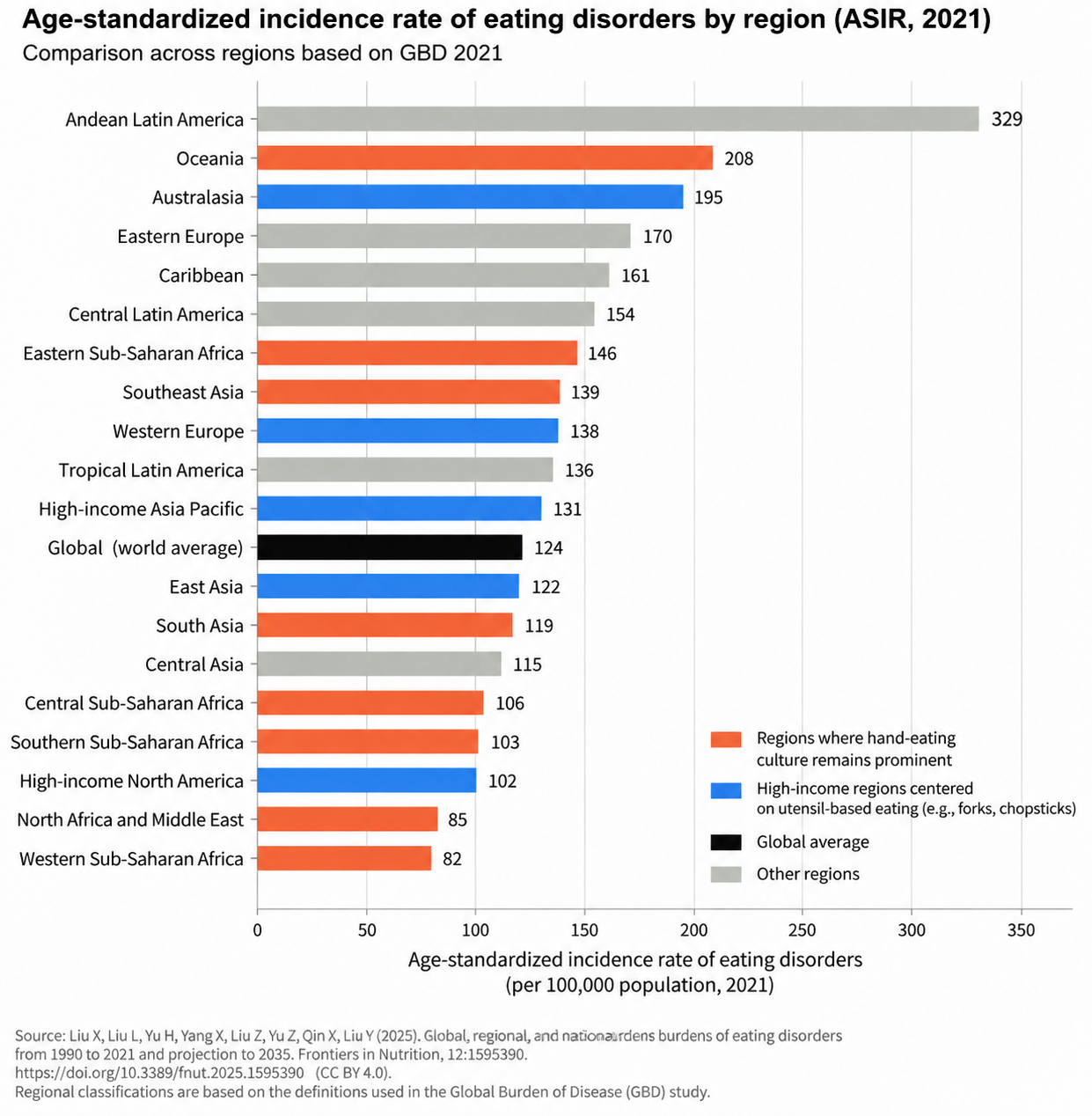
However, when I consulted the latest epidemiological model estimates from the Global Burden of Disease study (Liu et al., 2025; see figure below), it became clear that regional differences cannot be explained by the simple proposition that “eating disorders are uniformly less common in hand-eating cultures.” South Asia, for example, has an age-standardized incidence rate of 119 per 100,000, and Southeast Asia a rate of 139—figures that are in fact higher than those for high-income North America (102) and East Asia (122). Clearly lower rates are found only in certain regions, including North Africa and the Middle East (85) and western sub-Saharan Africa (82).
Existing academic literature primarily identifies sociocultural factors such as urbanization, Westernization, and the internalization of thinness ideals as explanations for these regional differences. I have found no evidence that the distinction between eating with the hands and eating with utensils has itself been directly examined as a primary explanatory factor. Thus, even if the hypothesis that “eating disorders are less common in hand-eating cultures” may appear applicable to certain regions, it cannot be regarded as a consistent tendency across all such regions. At present, the factors with stronger academic support are those associated with Westernization; the perspective of hand-eating proposed here remains a hypothesis specific to this essay.
These statistics, however, require two important qualifications.
First, urbanization and Westernization have historically proceeded in close association with shifts toward utensil-based eating practices, making it methodologically difficult to treat them as entirely independent variables. Moreover, what precisely constitutes “Westernization”—the internalization of thinness ideals, media exposure, changes in diet, and so forth—varies from study to study, and the spread of utensil use may in some cases form part of this broader transformation.
Second, even in regions with strong traditions of hand-eating, such as South and Southeast Asia, shifts away from the practice have been noted, particularly in urban areas. Country- and region-level aggregate data such as those used in the GBD study cannot distinguish between populations that continue to eat with their hands and those that have already shifted toward utensil use.
Consequently, even if the incidence of eating disorders is high in these regions, this could conceivably be associated with a decline in hand-eating practices and therefore does not, in itself, disprove the hypothesis that hand-eating might have some inhibitory effect on the emergence of eating disorders. Conversely, the existing data do not positively support this hypothesis either. More precisely, neither interpretation has yet been empirically tested.
Hence, the hypothesis that eating disorders may be less prevalent in hand-eating cultures should be understood not as a fact conclusively established by corresponding primary sources, but as a hypothesis grounded in the author’s own clinical intuition: namely, that modern utensil-based cultures may distance us from primordial oral experience and attenuate forms of living rooted in the corporeality of infancy. Testing this hypothesis would require research considerably more fine-grained than country- or region-level aggregate statistics. Future studies would need to examine the extent to which hand-eating is actually practiced within the same region—for example, differences between urban and rural populations or across generations—and compare these patterns with the incidence of eating disorders.
Cultural Considerations: Proximity to Death, Eros/Thanatos, and the Question of Choice
I would like to emphasize again that the discussion that follows is not based on objective cross-cultural comparative data. Rather, it is a theoretical thought experiment of my own, taking Freud’s concepts of Eros—the life drive—and Thanatos—the death drive—as its point of departure. The association with the “proximity of death” discussed below should therefore be understood as a theoretical proposition separate from the preceding discussion of cultural regions in which eating disorders have been reported as relatively less prevalent.
It is also important to acknowledge that grouping hand-eating cultures together as cultures in which “death is close at hand” always carries the risk of reproducing a colonial framework in which particular regions or religions are characterized as “uncivilized” or “primitive.” In reality, hand-eating is practiced and passed down not only in regions where poverty or conflict may make death more immediate, but also in affluent societies for religious and cultural reasons—for example, in Islamic and Hindu traditions in which eating with the hand may be regarded as a particularly pure or proper way of eating.
Considered through Freud’s concepts of Eros and Thanatos, my hypothesis is that circumstances in which death becomes more immediate may intensify the drive toward life, and that eating directly with the hands may serve to heighten the embodied sense of being alive. In observations drawn from my own clinical experience, for example, elderly people approaching the end of life may begin to eat with their hands. From a psychoanalytic perspective, my interpretation is that the proximity of death may intensify the drive toward life (Eros), with the direct act of hand-eating emerging as one possible bodily expression of that drive.
I would further propose that in utensil-based eating cultures, the choice between “eating” and “not eating” may become more explicitly available to conscious awareness. This does not mean, of course, that people in hand-eating cultures lack choices about food or the freedom not to eat. Rather, my suggestion is that utensils, as mediating objects, create a certain distance between the body and the act of eating, and that within this distance the very choice of “eating/not eating” may become more readily objectified.
The tendency frequently encountered in the clinical context of eating disorders—to make eating itself an object of conscious choice and control—may perhaps become intensified within this distance. By contrast, in a mode of eating in which the hand comes into direct contact with food, the conditions for such objectification and transformation into conscious choice may arise to a relatively lesser degree, allowing the drive toward life to find more direct expression. This is the theoretical proposition advanced in the present essay.
Conclusion: Hand-Eating as the Cultural Preservation of a Primordial Circuit
Hand-eating is a complex cultural practice that may carry several psychoanalytic meanings:
• A tactile operation that facilitates the integration of the body image
• A practice that makes visible the ways in which the Symbolic inscribes itself upon the body
• An act through which the materiality of the Real is received directly
• A cultural preservation of the primordial structure of the mother–infant relationship
In this sense, hand-eating quietly preserves within everyday life one of the earliest circuits through which the subject begins to form a relationship with the world. It is a gesture at the threshold where a human being enters the world and the body first comes into contact with it. As such a primordial configuration, hand-eating continues to live quietly within our everyday lives.
-
<References>
|Japanese-Language Sources|
アンジュー, D.(1993).『皮膚―自我』福田素子訳.言叢社.(原著:Anzieu, D. (1985). Le Moi-peau. Paris: Dunod.)
ウィニコット, D. W.(2015).『改訳 遊ぶことと現実』橋本雅雄・大矢泰士訳.岩崎学術出版社.(原著:Winnicott, D. W. (1971). Playing and Reality. London: Tavistock.)
国立精神・神経医療研究センター.摂食障害情報ポータルサイト.https://edcenter.ncnp.go.jp/(地域別・国別の摂食障害疫学データの参照先)
クライン, M.(1985).「分裂的機制についての覚書」小此木啓吾・岩崎徹也編訳『メラニー・クライン著作集4 妄想的・分裂的世界』誠信書房.(原著:Klein, M. (1946). Notes on some schizoid mechanisms. International Journal of Psycho-Analysis, 27, 99–110.)
新宮一成(1995).『ラカンの精神分析』講談社現代新書.
竹内健児(2005).『ドルトの精神分析入門』誠信書房.
「手食文化」.Wikipedia日本語版.最終閲覧2026年9月5日.https://ja.wikipedia.org/wiki/手食文化(地域分布の概観として参照。一次資料による裏づけは今後の課題)
フロイト, S.(2009).「性理論三篇」渡邉俊之訳,新宮一成ほか編『フロイト全集6 1901–06年 症例「ドーラ」/性理論三篇』岩波書店.(原著1905年刊)
ラカン, J.(1953).「象徴的なもの、想像的なもの、現実的なもの」.(Lacan, J. (1953). Le symbolique, l’imaginaire et le réel. Bulletin de l’Association freudienne, 1, 4–13.)
ルロワ゠グーラン, A.(2012).『身ぶりと言葉』荒木亨訳.ちくま学芸文庫.(原著:Leroi-Gourhan, A. (1964–65). Le Geste et la Parole. Paris: Albin Michel.)
|Western-Language Sources|
Dolto, F. (1984). L’Image inconsciente du corps. Paris: Éditions du Seuil.(未邦訳。日本語による解説は竹内, 2005を参照)
Liu, X., Liu, L., Yu, H., Yang, X., Liu, Z., Yu, Z., Qin, X., & Liu, Y. (2025). Global, regional, and national burdens of eating disorders from 1990 to 2021 and projection to 2035: Findings from the Global Burden of Disease Study 2021. Frontiers in Nutrition, 12, 1595390. https://doi.org/10.3389/fnut.2025.1595390(CC BY 4.0;本文中の図版のデータ出典)
Nasser, M., Katzman, M. A., & Gordon, R. A. (Eds.). (2001). Eating Disorders and Cultures in Transition. Hove: Routledge.
Winnicott, D. W. (1953). Transitional objects and transitional phenomena. International Journal of Psycho-Analysis, 34, 89–97.
[Editor’s Note]
Lacan’s three registers refer to a framework for understanding the human experience of the world through three distinct dimensions: the Imaginary, the Symbolic, and the Real. A deeper understanding of this framework would require familiarity with Lacan’s concept of the “mirror stage,” which he presented at the International Psychoanalytical Association, as well as with Freudian theory and its application in clinical practice. For the purposes of considering hand-eating, however, the account provided in this essay offers a sufficient point of reference.
Profile
Kenichiro Takahashi
Certified Public Psychologist and Clinical Psychologist specializing in psychoanalysis and clinical psychology. Has accumulated approximately 20,000 hours of clinical practice across a wide range of settings at two acute-care general hospitals. Currently works as a school counselor in an educational setting.
Leave a
Comment